FAQ
Stonemasonry questions, answered
Straight answers to the questions we're asked most. Can't find yours? Call Blake.
General questions
Are you a licensed stonemason?
Yes. Northern Beaches Stone is run by Blake Cooper, who holds NSW contractor licence 328680C in the Stonemason class. You can check it on the Service NSW licence check. In NSW, a contractor licence is needed for residential building work valued at more than $5,000 including labour and materials, and home building compensation (HBC) cover is required for residential jobs over $20,000.
What areas do you service?
Northern Beaches Stone is based in Narrabeen and works across Sydney's Northern Beaches, from Manly to Palm Beach, including the Forest district and Pittwater. We also cover the Lower and Upper North Shore, from Mosman and North Sydney through Chatswood and Lane Cove to Wahroonga and Hornsby. Jobs in other parts of Sydney are by arrangement, so ask us.
How much does stonemasonry cost, and are quotes free?
The cost of stonemasonry depends on the type and grade of stone, the size and height of the work, site access, excavation and any rock in the ground, drainage, and whether engineering or approval is needed. Because every Sydney site is different, we price each job individually. Quotes are free and no-obligation: we visit, measure up and give you a written quote.
What is included in a stonemasonry quote?
Our written quote for stonemasonry sets out the scope of work and what the price covers, such as stone supply, excavation, footings, drainage behind walls, mortar and fixings, sealing, clean-up and waste removal, and GST. Where something cannot be priced until work starts, like rock hidden below the surface, we say so in the quote. That makes it easier to compare quotes on the same basis.
What deposit do you take, and will I get a written contract?
For residential building work in NSW, the Home Building Act caps the deposit at 10% of the contract price, and any job over $5,000 needs a written contract. We work within those rules. For residential jobs over $20,000, home building compensation (HBC) cover is also required, and you should receive the certificate of insurance before you pay a deposit.
How soon can you start, and how long will my stonework take?
Start dates depend on our schedule, stone supply and any approvals your project needs. Most residential stonework, such as a garden wall, steps or a fireplace, takes a few days to a couple of weeks depending on size, while larger retaining walls and facades take longer. We will give you a timeline with your quote and keep you posted if weather or supply changes it.
Do you handle council approvals and engineering for retaining walls?
In NSW, a retaining wall is only exempt from approval if it meets the Codes SEPP limits, including a maximum height of 600 mm and at least 1 m from each boundary. Taller or boundary walls usually need a CDC or DA and an engineer's design. Where a wall needs approval, we build to the engineer's design and work with your engineer, certifier and Council, plus any other licensed contractor the approval requires.
Do you use local or imported sandstone, and can you use recycled stone?
Most of our work is in Sydney sandstone, also called Hawkesbury sandstone, in sawn, split-face and rock-face finishes. We choose the grade of stone for how exposed the work will be. We also work with bluestone and travertine, and can use recycled sandstone, which is often the best match for older Sydney homes. Recycled supply varies, so we source it for each job.
Do you supply the stone, or can I supply my own?
Either. For most stonemasonry jobs we supply the stone, so we can choose the grade and finish to suit the work. We can also lay stone you have bought or saved, including recycled sandstone from an old wall on your property. Before we start, we check that the stone is sound and that there is enough of it, and we allow for offcuts and waste.
Do I need to seal sandstone, and how often?
Sealing is recommended for sandstone paving, pool coping, fireplace hearths and walls exposed to salt air on the Northern Beaches. Use a breathable penetrating (impregnating) sealer rather than a surface coating, so moisture can still escape the stone. How often to reseal depends on the sealer and how much wear the stone gets: pool coping and busy paving need attention more often than a garden wall.
Do you work with builders, architects and landscape designers?
Yes. Northern Beaches Stone works with builders, architects and landscape designers on residential, commercial, high-end and heritage projects across Sydney's Northern Beaches and North Shore. We can build from your drawings and specifications, price the stonework package, and fit our work into the wider building programme, including cladding, fireplaces, retaining walls, steps, paving and stone restoration.
How do you manage dust, noise and mess on site?
Cutting sandstone creates fine dust, so our usual approach on site is to wet cut where we can, set up cutting away from doors, windows and neighbours, and clean up as we go. We agree on access, stone storage and working hours with you before we start, and leave the site tidy at the end of the job. Some noise from saws and machinery is unavoidable on any stonemasonry job.
What warranty applies to stonemasonry work?
In NSW, statutory warranties under the Home Building Act apply to residential building work, including stonemasonry done under a contract. They run for 2 years for non-major defects and 6 years for major defects, and they apply whether or not they are written into the contract. For details on how the warranties apply to your job, see NSW Fair Trading or ask us when we quote.
Can I see examples of your work near me?
Yes. Our projects page shows finished stonemasonry from around Sydney's Northern Beaches and North Shore, including a sandstone fireplace and garden walls at Bilgola Beach, sandstone cladding, retaining walls, steps, crazy paving and pool surrounds. Every service page also has a gallery of our work. If you want to see something specific, such as a retaining wall similar to yours, ask us when you get in touch.
Sandstone Retaining Walls
Do sandstone blocks need a footing?
Yes. A mortared or retaining sandstone wall needs a level, solid base under the first course, either a concrete footing or sound bedrock cut level. Where a wall needs engineering, the engineer sets the footing size and reinforcement, and it is built by the appropriately licensed contractor before the stonework starts.
Do I need approval to replace an old retaining wall?
Often, yes. Replacing a retaining wall is treated like building a new one, so the same exempt development limits apply: no more than 600 mm high, at least 1 m from boundaries and not on a heritage item, among others. Taller or boundary walls need a CDC or a DA. See our retaining wall approval guide.
Do I need council approval for a sandstone retaining wall in NSW?
Under the NSW Codes SEPP, a sandstone retaining wall is exempt development only if it is no more than 600 mm high, at least 1 m from every boundary, 2 m from other retaining walls, 40 m from a natural waterbody, not on a heritage item and does not redirect water onto neighbours. Anything else needs a complying development certificate or a development application with Northern Beaches Council.
When does a retaining wall need an engineer?
A retaining wall typically needs engineering design from around 1 m high, and at any height when it supports a driveway, pool, building or sits on a boundary. On many Northern Beaches slopes a geotechnical report is also needed before a significant wall can be approved. We build the sandstone wall to the engineer's design and work with your engineer and certifier.
What drainage goes behind a sandstone retaining wall?
A sandstone retaining wall needs a drainage zone of free-draining gravel or crushed sandstone, geotextile fabric to keep soil out, and a slotted agricultural pipe at the base falling to a legal discharge point, with weep holes where the design calls for them. Poor drainage is the most common cause of retaining wall failure, so it goes in before the backfill.
Sawn or rock-face sandstone blocks: which is better?
Neither is stronger in a well-built retaining wall; the choice is mostly about looks and budget. Sawn sandstone blocks give clean lines and tight joints for modern homes and cost more. Rock-face or split-face blocks have a textured, traditional face that suits older houses and bushland gardens on the Northern Beaches. We can show you both finishes on site.
How much does a sandstone retaining wall cost?
A sandstone retaining wall is usually priced on the area of wall face, then adjusted for the site. Height, block type, access, rock excavation, drainage and any engineering or approval fees make the biggest difference. Because Northern Beaches sites vary so much, we measure up and give you a free, no-obligation quote rather than a guess.
How long does a sandstone retaining wall last?
Built on a sound footing with proper drainage, a sandstone retaining wall is effectively permanent. Sydney has sandstone walls that are well over 100 years old and still standing. By comparison, a timber sleeper retaining wall typically lasts 15 to 20 years. Keeping the drainage clear is the main maintenance a sandstone wall needs.
Sandstone Fireplaces
How much does a sandstone fireplace cost?
A sandstone fireplace is priced per job. The size of the wall, the stone and finish (sawn ashlar, split-face or rubble), the hearth and mantel, any substrate or support work, and the gas or flue work by other trades set the cost. We measure up and give you a free written quote.
Will sandstone crack from the heat of a fireplace?
Not when the fireplace is installed to the appliance maker's clearances. The firebox or insert takes the direct heat, and the sandstone surround and hearth sit outside it. Stone exposed to direct flame, such as the inside of a fire pit, needs a firebox or refractory lining, because direct high heat can crack or spall natural stone.
Can I mount a TV on a sandstone feature wall?
Yes, if the fixings go into solid backing rather than the stone face alone, and the TV sits outside the heat zone the fireplace maker specifies. We plan the TV position, cable conduit and any recess before the stone goes on, so nothing is chased into finished stonework.
Can sandstone be used around a gas fireplace?
Yes. Sandstone suits gas, wood and electric fireplaces, as long as the stonework follows the appliance manufacturer's clearances to combustibles and any heat-resistant backing it specifies. On a sandstone gas fireplace we plan the stone around the firebox and flue, and the gas connection is made by a licensed gasfitter. We build fireplaces like this across the Northern Beaches.
Can you clad my existing brick fireplace in sandstone?
Usually, yes. Cladding an existing brick fireplace in sandstone is a common Northern Beaches renovation, because solid brick is a good base for stone. We first check the brickwork, the hearth and the floor below for soundness and support, then fix the sandstone with suitable adhesive and mechanical ties. It updates a dated room without demolishing the fireplace.
Is a stone feature wall too heavy for my house?
A natural stone feature wall is heavy: thin natural veneer weighs roughly 58 to 73 kg per square metre and full-bed stone much more. That is fine on solid masonry or a suitable cement-based substrate with mechanical support, but stone must never be fixed to plasterboard. We check the wall and floor before quoting any sandstone fireplace or TV wall.
Do I need council approval for a wood heater on the Northern Beaches?
Yes. Installing a wood or other solid fuel heater on the Northern Beaches needs approval from Northern Beaches Council under the Local Government Act, and Council charges application and inspection fees. The heater must be installed to AS/NZS 2918 and meet the AS/NZS 4013 emissions standard. We build the sandstone fireplace surround and hearth to suit the approved appliance.
How do I clean soot off a sandstone fireplace?
Sandstone is porous, so soot and smoke can stain a sandstone fireplace if it sits too long. Brush off loose soot with a soft dry brush, then clean with a pH-neutral stone cleaner and water, avoiding acids and harsh household cleaners. Sealing the surround and hearth with a breathable penetrating sealer makes future cleaning much easier.
How long does it take to build a sandstone fireplace?
Most sandstone fireplaces and TV feature walls take a few days to a couple of weeks on site, depending on the size, the stone pattern, substrate work and how other trades such as the gasfitter and electrician are scheduled. We will give you a timeline with your quote, so you can plan around the work in your Northern Beaches home.
Sandstone Cladding
Natural sandstone cladding or stone-look panels: what is the difference?
Natural sandstone cladding is real stone, so every piece is different and it weathers in over time rather than wearing out. Stone-look panels are manufactured to imitate stone and repeat their pattern, and they can fade or show their edges. On Northern Beaches homes, natural sandstone also sits comfortably beside existing sandstone walls and the local landscape.
What can sandstone cladding be fixed to?
Sandstone cladding can be fixed to brick, concrete block, concrete or a suitable fibre-cement cladding system, using stone adhesive and mechanical fixings matched to the wall height and exposure. Natural stone commonly weighs 60 kg per square metre or more, so it should never be fixed to plasterboard. We check the substrate on every Sydney job before quoting.
Does sandstone cladding near the beach need sealing?
Sandstone cladding near the beach benefits from a breathable penetrating sealer. Salt air and wind-driven rain carry salts into porous stone, which can cause white efflorescence and eventually flaking. A penetrating sealer reduces water uptake and staining while still letting moisture escape. It cannot make sandstone fully salt-proof, so exposed Northern Beaches walls also need occasional cleaning.
How much does sandstone cladding cost?
Sandstone cladding is priced on the wall area, then adjusted for the stone type, the number of corners and openings, scaffolding, substrate preparation and access. A flat feature wall costs far less per square metre than a two-storey facade with window reveals. We measure up and give you a free, no-obligation quote for your Northern Beaches or North Shore home.
Can you match new sandstone cladding to old stone?
Yes. When new sandstone cladding has to sit beside an existing wall, we match the stone by colour, grain, face texture and coursing. Recycled sandstone is often the best match for older Northern Beaches homes because it has already weathered. Supply of recycled stone varies, so we source it for each project and show you samples first.
Do I need approval to clad my house in sandstone?
Cladding a house in sandstone often does not need approval when it simply changes the wall finish, but heritage items, heritage conservation areas and conditions on an existing development consent can restrict facade changes. If your home is on the Northern Beaches, check with Northern Beaches Council or your certifier before work starts, and we can work with them on the details.
Crazy Paving
How much does crazy paving cost?
Crazy paving is usually priced per square metre laid. The cost depends on the stone you choose, the base needed (a slab costs more than a path base), the shape of the area, access and sealing. Fitting irregular pieces takes more labour than square pavers. We measure up and give a free, no-obligation quote for Northern Beaches and North Shore jobs.
Should crazy paving be laid on a concrete slab?
For durable paths, patios and pool areas, crazy paving is best laid on a concrete slab or a well-compacted, bound base, with the stone bedded in mortar. Laid on sand alone, the irregular pieces tend to rock, sink and lift. Driveways need thicker stone on a reinforced slab. We plan the base for each Northern Beaches site before quoting.
Sandstone or bluestone crazy paving: which gets hotter?
Bluestone crazy paving gets hotter in the sun because it is darker and denser. Sandstone crazy paving is lighter in colour and stays comparatively cool underfoot, which is why many Sydney pool owners prefer it for bare feet. Bluestone is harder-wearing and less porous, so the right choice depends on sun, use and the look you want.
Is crazy paving slippery around a pool?
Natural split stone crazy paving generally has good grip around a pool because its surface is textured, not polished. Slip risk rises with polished or very smooth finishes, algae in shaded spots and some film-forming sealers. For pool surrounds on the Northern Beaches we use textured stone, keep the falls right so water drains away, and use a penetrating sealer.
Do you need to seal crazy paving?
Sealing is recommended for sandstone crazy paving. A breathable penetrating sealer reduces staining, water uptake and salt damage while letting moisture escape from the stone. Pool areas and busy paths need resealing more often than a quiet garden path. Do not seal crazy paving where moisture is rising from below, as it can trap salts and damage the stone.
Sandstone Paving
What is the difference between sandstone flagging and sandstone pavers?
Sandstone flagging is usually sawn top and bottom, comes in larger or random sizes, and gives an even, natural stone surface for terraces and courtyards. Sandstone pavers are generally uniform in size and thickness, which makes them quicker to lay in regular patterns. Both suit Northern Beaches homes; the choice comes down to look, thickness and budget.
Is sandstone good for driveways?
Sandstone can work for a driveway, but only as thicker stone laid on a reinforced concrete slab designed for vehicle loads. Thin sandstone pavers on sand will crack and move under cars. Sandstone is also porous, so oil and tyre marks need prompt cleaning and the surface should be sealed. We advise on stone thickness for each Sydney driveway.
How often should sandstone pavers be sealed?
How often sandstone pavers need resealing depends on the sealer, sun, foot traffic and whether they surround a pool. A quality breathable penetrating sealer can last many years in low-traffic areas, while pool surrounds and busy paths on the Northern Beaches need attention more often. If water stops beading on the surface, it is time to reseal.
Why are my sandstone pavers turning white or black?
White deposits on sandstone pavers are usually efflorescence, which is salt carried up by moisture that crystallises as the stone dries. Black or green marks are usually mould, algae or lichen in shady, damp areas. Both are common on the Northern Beaches and can be cleaned. Better drainage and a breathable penetrating sealer help stop them coming back.
Sandstone or travertine pavers: which is better?
Sandstone pavers have warm colour, good grip and suit Sydney sandstone homes and gardens. Travertine pavers have a smoother, more formal look, stay relatively cool underfoot and are popular around pools, but they have natural holes that may be filled or left open. Both are porous and need sealing. We can show you both side by side on site.
Sandstone Steps
How much do sandstone steps cost?
The cost of sandstone steps depends on the number and width of steps, the stone and edge finish, the footings, any rock cutting, curves and site access. Because these vary so much between Northern Beaches sites, we quote each stair after a site visit rather than giving a price per step. Call 0414 319 536 to arrange a free, no-obligation quote.
Can you put sandstone treads on my existing concrete stairs?
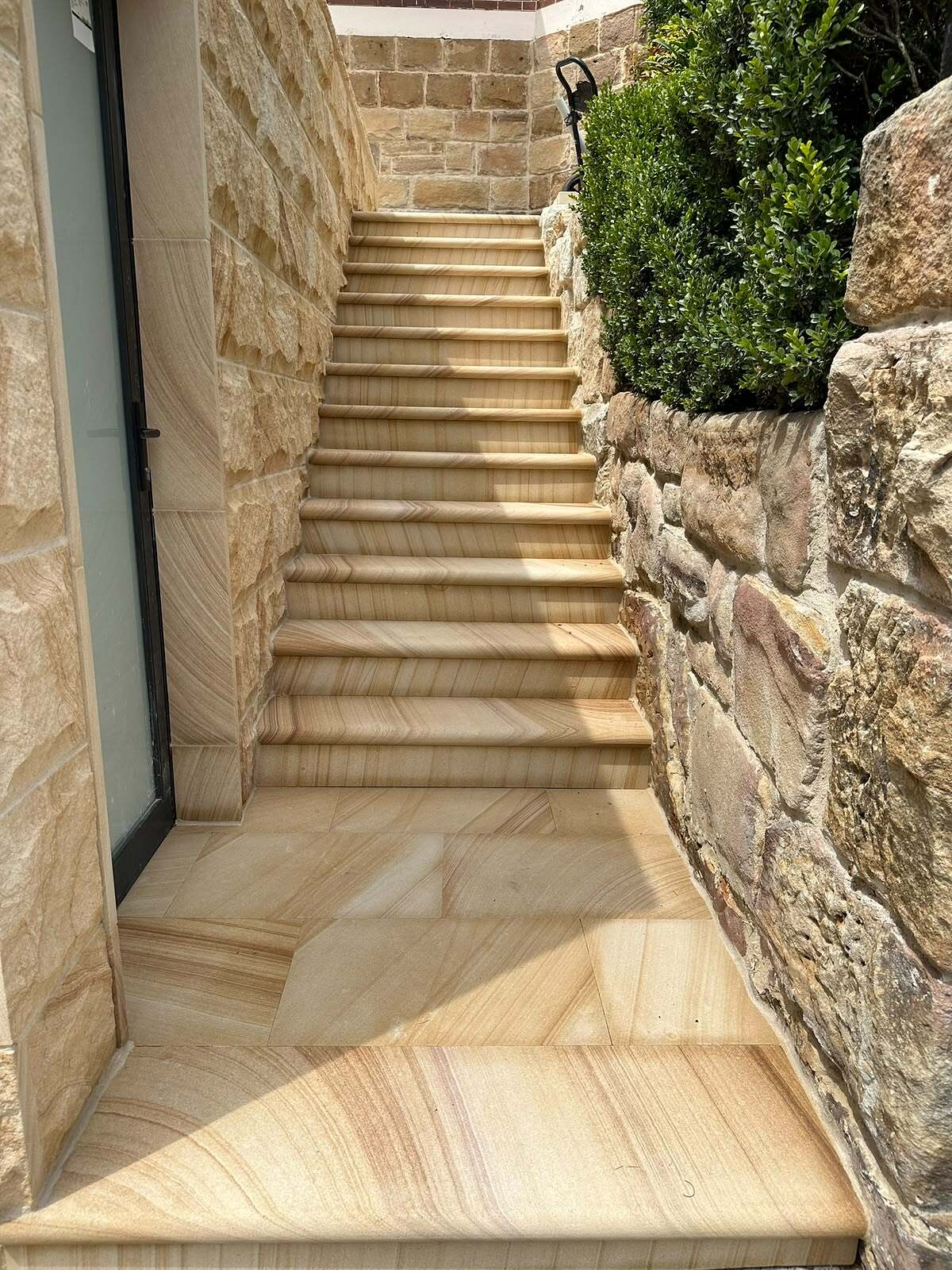
Yes, sandstone treads and risers can often be fixed over existing concrete stairs, as long as the stairs are structurally sound and the finished rises stay consistent. The stone adds height to each step, so we check the top and bottom levels and the door threshold first. If the old stairs are cracked or uneven, rebuilding may be the better option.
Are sandstone steps slippery when wet?
Sawn or textured sandstone steps have good natural grip, even when wet. The main slip risk on Northern Beaches stairs comes from leaf litter, moss, mould and lichen on shaded, damp stone. Keeping the steps swept, improving drainage and cleaning them with a stone-safe product keeps them safe. We avoid polished finishes on outdoor stairs.
What size should outdoor steps be?
For stairs serving a house, the National Construction Code sets limits on riser height and going depth and requires both to stay the same through each flight. Even rises are what make a stair feel comfortable and safe. When we build sandstone steps we set out the whole flight first, then work the step sizes to suit the levels and the code.
Do you build curved sandstone staircases?
Yes. We build curved staircases with sawn sandstone treads, often between curved rendered walls finished with sandstone coping. Each tread on a curve is cut to its own shape, so these stairs take more set-out and cutting than a straight flight. On a Northern Beaches or North Shore site visit we can talk through the layout, wall finish and tread options.
Can you repair or restore old sandstone steps?
Yes, we are often asked to restore old sandstone steps on the Northern Beaches. Worn or loose treads can be re-bedded, damaged stones replaced with matched or recycled sandstone, joints repointed and the stone cleaned without harsh pressure washing. Restoring sound old steps often costs less than replacing them and keeps their character.
Sandstone Pool Coping
Can I use sandstone coping on a saltwater pool?
Sandstone can work around a saltwater pool if you choose a dense, good grade of stone, seal it with a breathable penetrating sealer and rinse it with fresh water regularly. Salt crystallising in the pores is what causes flaking, and sealing reduces it but does not stop it entirely. If you want less maintenance, travertine or bluestone coping may suit a Northern Beaches salt pool better.
What sealer should be used on sandstone pool coping?
Sandstone pool coping should be sealed with a breathable, penetrating (impregnating) sealer made for pool areas and salt exposure. Film-forming coatings trap moisture in the stone and can peel or go cloudy. A sealer reduces water, salt and stain uptake but does not make sandstone salt-proof, so re-apply it at the interval the manufacturer recommends, as pool coping wears faster than paving elsewhere.
Which pool coping stays coolest underfoot?
Light-coloured travertine and light sandstone stay the coolest underfoot around a pool. Dark stone such as bluestone absorbs more heat and can get hot in full summer sun. For Northern Beaches pools that get afternoon sun, we usually recommend a lighter stone for the coping and the surrounding paving.
Should I choose bullnose or drop-face pool coping?
Bullnose and drop-face pool coping are mostly a matter of style. Bullnose has a rounded edge that suits traditional pools and is comfortable to sit on. Drop-face coping has a thicker front face for a sharper, modern edge. Both can be cut from sandstone, travertine or bluestone, and we can show you samples on site.
How much does sandstone pool coping cost?
The cost of sandstone pool coping depends on the pool's size and shape, the edge profile, the stone grade, the number of corners and steps, and any paving or feature walls around it. Curved pools take more cutting than rectangles. We quote each Northern Beaches pool after a site visit, so call 0414 319 536 for a free, no-obligation quote.
How do you clean sandstone pool coping?
Clean sandstone pool coping by rinsing it with fresh water, scrubbing with a soft brush and using a pH-neutral stone cleaner for marks. Avoid acid cleaners and high-pressure washing close to the surface, as both damage sandstone. Regular rinsing removes salt and chlorine before they build up, which is the most useful habit for keeping pool coping in good condition.
Sandstone Letterboxes & Pillars
Can a sandstone letterbox include house numbers, lighting or a parcel box?
Yes. A sandstone letterbox pillar can include house numbers in stone or metal, a built-in parcel box and lighting or an intercom. We leave conduit in the pillar as we build it, and all electrical work is done by a licensed electrician. Planning these extras before we start avoids cutting into the finished stonework later.
Do front fences or pillars need council approval?
In NSW, a low front fence can be exempt development under the Codes SEPP if it meets the height, location and material standards. Heritage items, heritage conservation areas, corner lots and some bushfire-prone land have different rules, and taller sandstone fences or pillars usually need approval. Northern Beaches Council can confirm what applies to your lot, and we can help you check.
Where should my letterbox go for Australia Post?
Australia Post asks for a letterbox at or near the front boundary, easy for the postie to reach from the street without entering the property, and clearly marked with the house number. The opening should take standard mail and small parcels. When we build a sandstone letterbox on the Northern Beaches, we plan the position and height with this in mind.
How long does a sandstone letterbox take to build?
A single sandstone letterbox pillar usually takes a few days on site, allowing for the footing to cure, the stonework and the capping. A front wall or a run of fence piers takes longer, depending on the size and the stone. We will give you a timeline with your quote, so you know what to expect.
Can you match my existing sandstone fence or house?
Yes. We can match an existing sandstone fence, wall or house using new or recycled sandstone, choosing stone for colour, texture and finish. Older Northern Beaches walls are often best matched with recycled sandstone, which has already weathered. We look at the existing stone on site and bring samples where we can.
How much does a sandstone letterbox cost?
The cost of a sandstone letterbox depends on its size, the stone and finish, the footing, the letterbox or parcel box unit and any numbers, lighting conduit or matching to existing stone. Gate pillars and front walls are priced on the same factors. We quote after a site visit, so call 0414 319 536 for a free, no-obligation quote.
Sandstone Fire Pits & Features
Is sandstone good for fire pits?
Sandstone makes a good fire pit if it has a refractory lining, such as firebrick in refractory mortar or a steel insert. Direct high heat can crack or spall natural stone, so the flames should never sit against the face stone. With a proper lining and drainage in the base, a sandstone fire pit will last for many years in a Northern Beaches garden.
Are fire pits allowed on the Northern Beaches?
Fire pits are generally allowed on the Northern Beaches for warmth or cooking, but not on days of a total fire ban declared by the NSW Rural Fire Service. Sydney's clean air rules do not allow burning garden waste, and you should use dry, clean firewood to keep smoke down. Check current fire danger ratings before you light a fire pit.
Can you build sandstone seating around a fire pit?
Yes. We build sandstone seating walls around fire pits at a comfortable seat height, capped with sawn coping wide enough to sit on. The seating can be curved to follow a round fire pit or set as straight benches beside a rectangular one, and it can double as a low retaining wall on a sloping Northern Beaches block.
What sandstone garden edging lasts the longest?
Sawn sandstone edging or sandstone blocks bedded on a concrete haunch last the longest. The haunch stops the edging moving as the lawn is mown and the soil settles, and it holds smooth curves in place. Loose-laid edging tends to drift and sink over time, especially in sandy Northern Beaches soils.
Can you build an outdoor shower wall in sandstone?
Yes. We build outdoor shower walls clad in split-face or sawn sandstone, with waterproofing behind the stone so water does not get into the wall. A licensed plumber fits the tapware and connects the drainage. We plan the stonework around the fittings you choose, so the shower rose and taps sit neatly within the stone.
How much does a sandstone fire pit cost?
The cost of a sandstone fire pit depends on its size and shape, the stone and finish, the refractory lining or insert, any seating walls, gas connections and site access. Round pits take more cutting than square ones. We quote each fire pit after a site visit, so call 0414 319 536 for a free, no-obligation quote.
Sandstone Restoration
Why is my sandstone crumbling or flaking?
Sandstone usually crumbles or flakes because of salt attack, where salts carried by moisture crystallise in the stone as it dries. Hard cement mortar makes it worse by forcing moisture out through the stone instead of the joints. Coastal salt air, rising damp and poor drainage are common causes on the Northern Beaches. Finding the moisture source is the first step in any repair.
Should you use lime or cement mortar on sandstone?
For older and heritage sandstone, use a breathable lime mortar that is softer than the stone. Lime mortar lets the wall dry through the joints, so salts and decay go into the mortar, which can be replaced. Cement mortar is harder and less permeable, which forces moisture through the sandstone and damages the edges of each block over time.
Can old sandstone be cleaned without damaging it?
Yes. Old sandstone can be cleaned safely with low-pressure water, soft brushes, stone-safe cleaners and poultices for stubborn stains. High-pressure washing, sandblasting and acid cleaners strip the surface of the stone and speed up weathering, so we avoid them. A gentle clean removes dirt, mould and staining while keeping the stone's face intact.
Do I need approval to repair a heritage-listed sandstone wall?
Work to a heritage-listed sandstone wall in NSW usually needs Council consent under the local environmental plan. Some minor repairs and maintenance can proceed without consent if Council confirms in writing beforehand that the work is minor. On the Northern Beaches, check with Council first, and we can work with your heritage adviser on the repair method.
Can you replace damaged sandstone blocks so they match?
Yes. We cut out decayed sandstone and set in indents or full replacement stones cut from matched new or recycled sandstone. Recycled stone has already weathered, so it often blends better with old Sydney sandstone walls. We match colour, grain, size and tooling, then repoint the joints in lime mortar to suit the original.
How much does sandstone repointing cost?
The cost of sandstone repointing depends on the area, joint depth and width, the mortar type, how much cement has to be raked out, access and any stone replacement. Heritage work may also need specific methods. We quote each Northern Beaches and North Shore job after an inspection, so call 0414 319 536 for a free assessment.